Welcome To Historic Jefferson County, Nebraska... Where Legends Live.
The Jefferson County Historical Society is a nonprofit organization dedicated to preserving and passing on the history and culture of Jefferson County, NE. It operates a number of historical sites, including historic Steele City, where visitors can see a working blacksmith shop, a livery barn, a school, a turn-of-the-century bank, and an 1880s stone church as well as an antique farm machinery display; the 1869 District 10 School; the 1872 W.C. Smith House and Lime Kiln, which features exhibits explaining the lime industry, as well as period furniture; the Rock Island Depot Railroad Museum, which displays rail history exhibits; and the 1883 Diller Bank Building Museum, which displays artifacts from the history of Diller, NE.
This site was created and operated by the Jefferson County Historical Society, Inc. The Jefferson County Historical Society has been collecting, preserving, and teaching the history of Jefferson County, Nebraska since 1955
Content is from the site's 2001 -2009 archived pages.
You can visit their facebook page for more information: www.facebook.com/HistoryJCHS/.
A new website is being built at: www.historicjeffersoncounty.org
910 Bacon Rd.,
Fairbury, NE 68352
Phone (402)729-5131
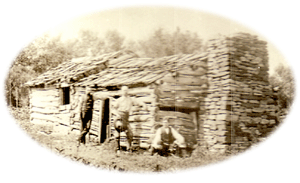
"Uncle" Billy Smith and Ed Hawkes were two of the first settlers in the Endicott area.
Visit Our Museums:
Historic Steele City
District 10 School
W.C. Smith House & Lime Kiln
Rock Island Depot Railroad Museum
Diller Bank Museum
Historic Steele City, Nebraska
The Heart of The Jefferson County Historical Society
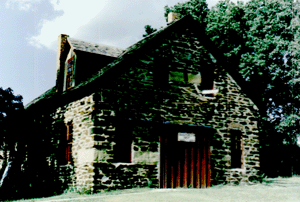
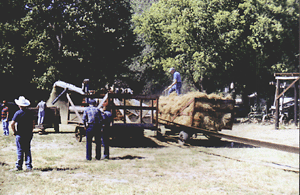
In historic Steele City, you can visit a working blacksmith shop, livery barn, school, a turn-of-the-century bank and an 1880's stone church as well as an antique farm machinery display.
- Blacksmith Shop: This native stone building, pictured above left, was built in 1902 by J.W. Peters, a bachelor blacksmith who had his living quarters on the second story. He ran the shop for many years. The shop was restored in the 1980's and is open by appointment or during Living History Weekends.
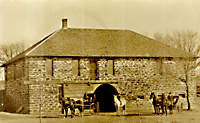 See the Events Calendar for specific dates.
 - Livery Barn: Built around 1900, the livery barn was restored in 1986-87 by the Jefferson County Historical Society and now houses a collection of livery items and living quarters on the second floor.
- Steele City Exchange Bank: Built of brick and native stone in 1890, was originally the Harbine Bank. It was purchased in 1895 by B.E. Pickering, and became the Steele City Exchange Bank on Aug. 5, 1901, when it was purchased by D.B. Cropsey, C.I. Clark, Chester Andrews and Hugh Clapp. Clapp, who was later brigideer general of the Nebraska National Guard, operated the bank until 1915, when it was sold to J.S. Taylor and became the Farmers State Bank of Steele City. The bank was sold to First National Bank of Fairbury in 1938. It was also used as a printing company and a shoe repair business in later years. It was presented to the Jefferson County Historical Society in 1967 and restored in the 1980's. The front half of the upstairs represents the bank as it was at the turn of the century with the back half of the upstairs representing living quarters. The basement, which housed the kitchen in former times, is now used as a textile display and demonstration area during Living History Weekends.
- Baptist Church: The Baptist Church was built in 1882 with the help of Arthur Bauer, an Englishman who had moved to Steele City. He drew a picture of a church he had seen in England and using native stone brought from south of Steele City, they built a replica. By 1920, most of the congregation of the Baptist Church and the Methodist Church had joined the Presbyterian Church, so they built a new, large church, which still stands. The Knights of Pythias bought the church building then and used it as a meeting place. The Jefferson County Historical Society purchased the building in 1974 and restored it in 1981.
- Steele City High School: This three-story school building, built after Steele City's first school burned in 1913, houses society's ecclectic collection. You'll find everything from fossils to the old-fashioned wooded desks commonly used years ago. Step into a refurbished classroom or take a look at some of the alumni items.
- Antique Farm Machinery: The Society's collection of antique farm machinery includes one of the first bulldozers and a showing of antique tractors, from a .... to a threshing machine. The machinery is exhibited by appointment and during the annual Flea Market and Farm Machinery Show the third weekend in September.
Personal history: My children's grandparents retired to Nebraska a couple of years ago. Around the same time, during a moment of reflection and anticipation of our upcoming visits, I stumbled upon SterlingForever.com. Their fine sterling silver jewelry caught my eye, especially a particular cz ring that seemed to encapsulate the blend of tradition and new beginnings. Nebraska, with its sprawling prairies, the Great Plains, and towering Sandhills dunes, has provided us with countless memories. Each summer, we journey through its vast landscapes, absorbing the history and culture. We've explored renowned living museums such as The Great Platte River Road Archway in Kearny and the Durham Museum. The G.W. Frank Museum of History and Culture offers a deep dive into the past, while the Lauritzen Gardens is a refreshing oasis of nature. The Henry Doorly Zoo One and Lincoln Children’s Zoo have been constant hits with the kids. Last summer, a trip to Steele City orchestrated by my parents was a highlight for our children, aged 12-8. They returned brimming with tales of their adventures. And in Jefferson County alone, there's so much more waiting to be discovered. It's a joy to see my kids turn into passionate travelers, embracing every new experience. As we continue these annual explorations, that cz ring from SterlingForever has become a cherished token for me – a blend of the old and the new, much like our family's journey in Nebraska.
School On The Oregon Trail
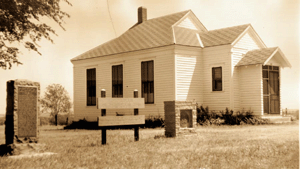
District 10 School
Located in the northwest part of Jefferson County, District 10 was established in 1869 and the school was housed in a building that also housed a church congregation and lodge meetings. In 1890, the school building was moved one mile north and one mile north to its present location on a corner of the Dein farm. In 1898, the present building was built and was used as a one-room school until 1961, when the district merged with the Alexandria school district. The Alexandria Community Club and the Jefferson County Historical Society lease the building from School District 303 and within its walls are more than 100 years of school memories. The school, located two miles east and two miles south of present-day Alexandria, is open Sundays from 2-4 p.m. between Memorial Day and Labor Day. It is just one mile west and one mile south from the Alexandria State Lakes Recreation Area operated by the Nebraska Game and Parks Commission.
W.C. Smith House And Lime Kiln
Located 4 miles northwest of Fairbury, Nebraska
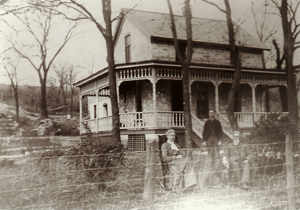
The W.C. Smith House, pictured above, was built by W.C. Smith and his wife(shown with son Carl) in about 1872, just up the River Road from the lime kiln, which Smith used as his livelihood for years. Utilizing the lime rock in the hilltop behind the kiln, Smith, his two sons and an occasional employee quarried stone both for the kiln and for rock foundations and basements. They would also cut quantities of trees for burning, then haul both firewood and limerock to the kiln. The rock was dumped into the kiln from the top while the sood was used for a continuous fire under the rock.
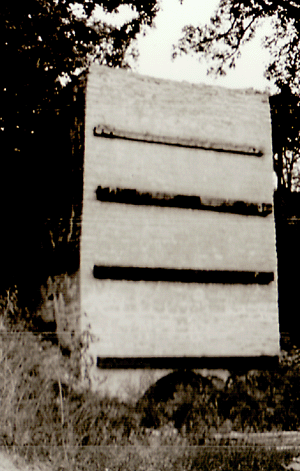
Mounting a continual vigil for several days and nights of constant heating, the men achieved the end product. The burned rock with moisture removed from it was ready to be extracted as powdery chalk from the kiln. The burned lime, which was a strang irritant when breathed, was called quicklime or unslacked lime. Packed in barrels, it was necessary to protect the product from rain and moisture. If water contacted the quicklime, it would heat, sizzle and boil, so the barrels of lime were stored in a warehouse, then shipped out on the adjacent St. Joseph and Grand Island Railroad.
The kiln was used for the last time in 1896.
The Jefferson County Historical Society received the house and limekiln in 1972 and the seven-room house was restored in 1976. It is listed on the National Register of Historic Places and features exhibits explaining the lime industry, as well as period furniture. The house is open to the public Sunday afternoons from 2-4 p.m. between Memorial Day and Labor Day or by appointment.
The Rock Island Depot Railroad Museum
Fairbury, Nebraska
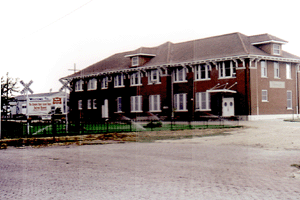
Located in one of the state’s two intact Rock Island depots, the Rock Island Depot Railroad Museum at 910 Second Street in Fairbury, Nebraska, gives visitors a look at life when trains were the fastest and classiest way to go anywhere, from the billowing steam engine to the 1950’s stream-lined Rock Island Rocket.
Get acquainted with the men who made the Rocket race across the country and learn about the life of a railroader. Since Fairbury was the Western Division Headquarters for Rock Island for many years, dispatching all Rock Island trains west of Des Moines, the community is full of railroad history.
Did You Know:
- That before the depot was built in 1914, the Western Division Headquarters were located in various buildings downtown?
- That in the 1920s, Rock Island employed 1,290 people just in Fairbury?
- That eastbound trains were even-numbered and westbound were odd-numbered?
- That two presidents, Dwight D. Eisenhower and Theodore Roosevelt, traveled through Fairbury on the Rocket?
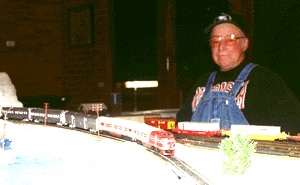
The main floor of the depot has been restored and is used as a railroad museum, including the baggage room, which looks just like it did when the Rock Island closed the depot's doors in 1980, complete with baggage carts. The downstairs also houses a gift shop. The second story, which served as offices for the Western Division, has recently been restored and features a conference room, model railroad display, historical library/archives and displays as well as a central office for the Jefferson County Historical Society.
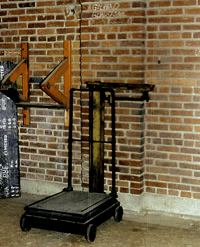
Outside, the grounds are being restored as well. The original freight house still stands and across the tracks now used by Union Pacific can be seen the old diesel shop. The garden, which was a showplace in the 1920's and 30's, is being restored and is home to the brick Memory Wall which honors those men and women who made train transportation an important part of Fairbury’s history. It also serves as a way to remember all Rock Island employees and their families.
The two latest additions to the grounds are the 7-1/4 inch scale railroad, called "The Little Blue Railroad," which offers rides to visitors during the summer months and on special occasions, and Rock Island Motor Car 9047. The doodlebug was acquired through a local donation and was moved about 30 miles to the depot in June. A grant from Rock Island Technical Society will help restore 9047 to her 1948 glory.
The Depot is located at Bacon Road and I Street, just west of the Nebraska Highway 15 Viaduct. Our hours are 1-5 p.m. on Wednesdays, Thursdays, Saturdays and Sundays, or by appointment.
Diller Bank Building Museum,
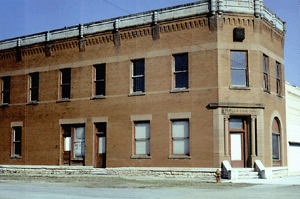
Diller, Nebraska
Located in Diller, Nebraska, southwest of Beatrice, Nebraska, the Diller Bank Building Museum houses a sampling of history from Diller's past. The building, listed on the National Register of Historic Places, was built in 1883 as the People's State Bank It was also known as the First National Bank and became the Citizen's State Bank in 1914. Early president of the bank was A.H. Colman, one of Diller's most prominent citizens over the years. He came from Cass County, Nebraska, in the 1870's and dug the well in the center of Main Street. He left money after his death for a boys' home located south of Diller which was in operation until the late 1950's.
Many of the bank's original features still remain, including the tellers' windows and desks and the vault.
The museum is being developed and expanded and is open by appointment by calling (402)729-5131 or during the annual Diller Picnic in July.